
The State of Multifamily — Stability, Selective Growth, and Why Las Vegas Continues to Outperform
The State of Multifamily: Stability, Selective Growth, and Why Las Vegas Continues to Outperform
As 2025 comes to a close and investors look toward 2026, the multifamily sector is once again proving why it remains one of the most resilient asset classes in commercial real estate. Despite elevated interest rates, affordability pressures, and pockets of new supply, the market is stabilizing—not unraveling.
Nationally, fundamentals remain intact. In markets like Las Vegas, they remain compelling.
National Multifamily Outlook: Bending, Not Breaking
Industry consensus points to a market that is adjusting, not collapsing. According to Multi-Housing News, multifamily fundamentals are being supported by:
-
Healthy vacancy levels
-
Renewed investor activity
-
A sharp slowdown in new construction
Units under construction nationally have fallen from nearly 1 million to roughly 400,000, a level not seen since the 1970s. This pullback in development is expected to tighten supply conditions over the next several years, particularly in growth-oriented metros.
At the same time, renter behavior is reinforcing stability. GlobeSt. reports that resident retention is at record highs, with stabilized occupancy holding between 94% and 95% nationwide. As LeaseLock Chief Economist Greg Willett notes, uncertainty has led renters to stay put rather than churn—while the buy-versus-rent equation continues to favor renting.
Western Markets: Performance Is No Longer Uniform
Across the Western U.S., divergence is the defining theme.
-
Coastal California metros continue to face regulatory friction, affordability constraints, and muted rent growth.
-
Parts of the Pacific Northwest are dealing with slower job growth and elevated supply pipelines.
By contrast, interior Western and Mountain markets are stabilizing more quickly. After absorbing heavy deliveries, many Sun Belt, Mountain, and Desert metros are now positioned to perform better in 2026—even if that improvement looks like steady stabilization rather than rapid expansion.
This is where Las Vegas stands apart.
Las Vegas: A Western Market With Sun Belt Fundamentals
Las Vegas continues to combine Western geography with Sun Belt economics. Population growth, job diversification, and relative affordability have kept demand durable—even during periods of aggressive new supply.
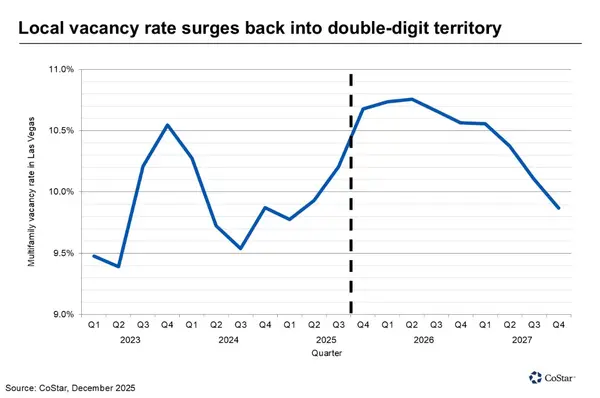
While concessions have been used as a pressure valve across the region, occupancy in Las Vegas remains healthy, and leasing velocity has held up better than many peer markets.
More importantly, the construction pipeline is now moderating just as demand remains steady—a setup that historically precedes improved rent growth and stronger pricing power.
According to Multi-Housing News, longer-term financing is returning as well, with more investors opting for 10-year loan structures—a signal of renewed confidence in asset stability and interest-rate normalization.
Why Las Vegas Continues to Outperform Western Peers
Compared to many coastal Western markets, Las Vegas offers:
-
Fewer regulatory barriers
-
Lower development and operating costs
-
Strong in-migration relative to housing costs
-
A diversified employment base extending beyond tourism
These fundamentals position Las Vegas not just to weather the next phase of the cycle, but to emerge stronger as supply tightens and capital re-enters the market.
Looking Ahead to 2026: Disciplined Optimism, Strategic Opportunity
The prevailing outlook for 2026 is not exuberance—it’s disciplined optimism.
National rent growth is projected to hover around 2%, with stronger performance expected in the back half of the year as lease rollovers align with easing supply pressures. Markets that pair demographic growth with construction moderation—like Las Vegas—are best positioned to outperform within the Western U.S.
For investors focused on durability rather than speculation, multifamily remains a cornerstone asset class. And within the West, Las Vegas continues to stand out as a market where fundamentals, policy environment, and population trends align.
If you’re evaluating multifamily opportunities in Las Vegas—or comparing Western markets for your next acquisition or disposition—HYDE Real Estate Group is ready to help you navigate the data, identify value, and execute with confidence.
FAQs: Multifamily Outlook and Las Vegas Performance
1. Is the multifamily market weakening in 2025?
No. The market is stabilizing, not breaking. Occupancy remains high, retention is strong, and new supply is slowing significantly.
2. Why is construction slowing so much?
Higher financing costs and tighter capital markets have reduced new starts, dropping units under construction to levels not seen in decades.
3. How does Las Vegas compare to other Western markets?
Las Vegas benefits from fewer regulations, lower costs, and stronger population growth than many coastal Western metros.
4. Are rents expected to grow in 2026?
Modestly. National forecasts point to ~2% growth, with stronger performance expected in markets where supply is tightening.
5. Why is investor confidence improving?
More buyers are returning to longer-term financing, signaling confidence in asset stability and normalized rate environments.
6. Is Las Vegas a good market for long-term multifamily investors?
Yes. Its combination of demand durability, supply moderation, and business-friendly environment makes it one of the strongest multifamily markets in the Western U.S.
Categories
Recent Posts





GET MORE INFORMATION