
Las Vegas Multifamily Market Snapshot (October 2025): Supply Cliff Ahead Creates Strategic Buying Window
Las Vegas Multifamily Market Snapshot | October 2025
As of October 2025, the Las Vegas multifamily market is clearly shifting gears. After several years of heavy development and temporary oversupply, the data now points toward stabilization today and tightening conditions ahead. For investors, this creates a rare window where pricing is soft—but long-term fundamentals are strengthening.
Market Overview: Construction Is Falling Fast
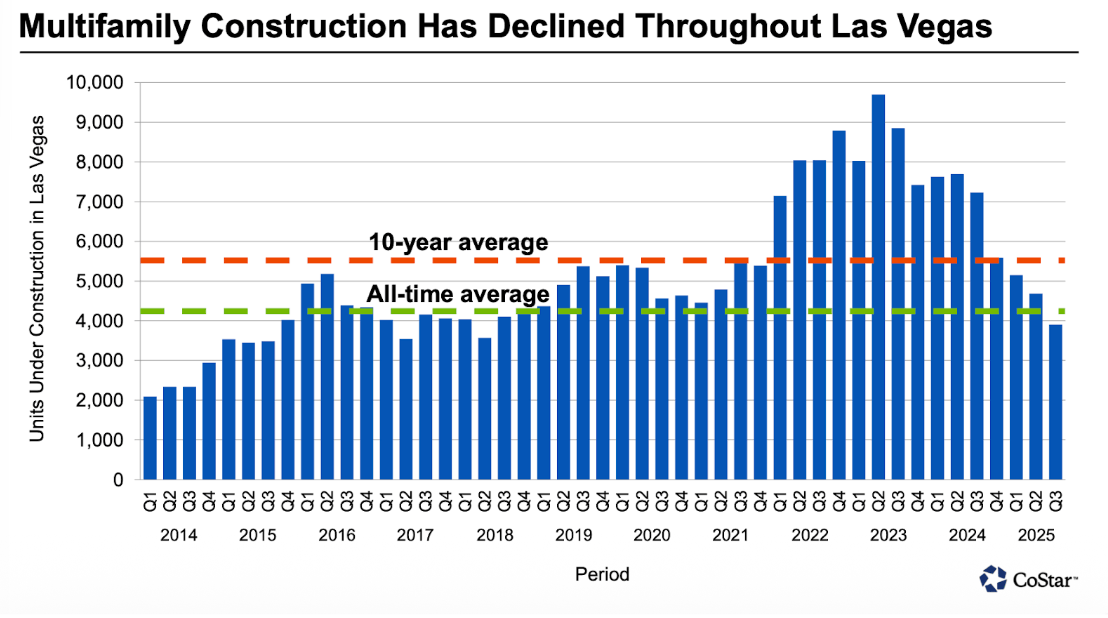
Construction activity across Las Vegas has dropped sharply, signaling a potential supply cliff by 2027.
Key Construction Trends (2014–2025):
-
Deliveries peaked in 2023, marking the top of the recent development cycle
-
Units under construction have fallen below 5,000, down from highs above 9,000
-
Few new projects are breaking ground due to financing costs and construction inflation
This slowdown matters because multifamily markets typically tighten 12–24 months after construction pipelines collapse.
Investor Insight:
2025–2026 represents a strategic buying window—before reduced supply translates into stronger rent growth and rising asset values.
Vacancy & Rents: Oversupply Is Being Absorbed
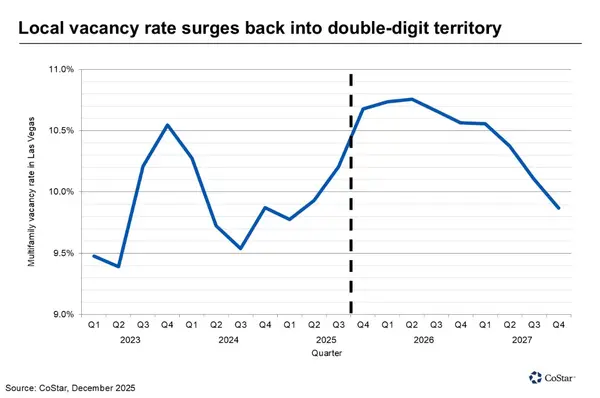
Vacancy Trends
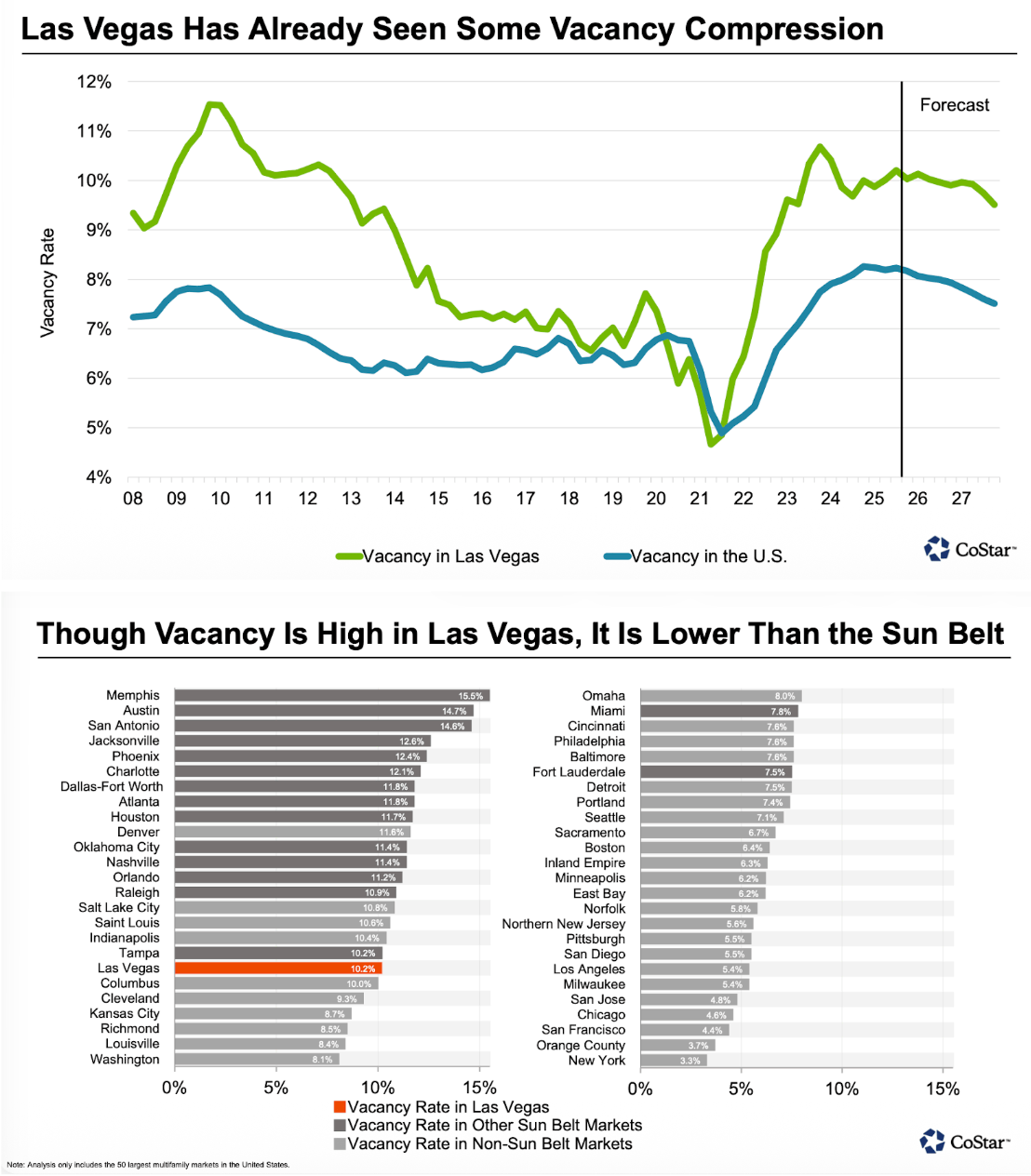
Vacancy rose to approximately 10%, driven largely by lease-up pressure from newly delivered Class A properties. However, vacancy has begun to compress, and many stabilized assets are already outperforming market averages.
Notably:
-
Even newly delivered communities are stabilizing near 9% vacancy
-
Las Vegas vacancies remain lower than peer Sun Belt markets like Phoenix and Austin
Rent Growth & Concessions
-
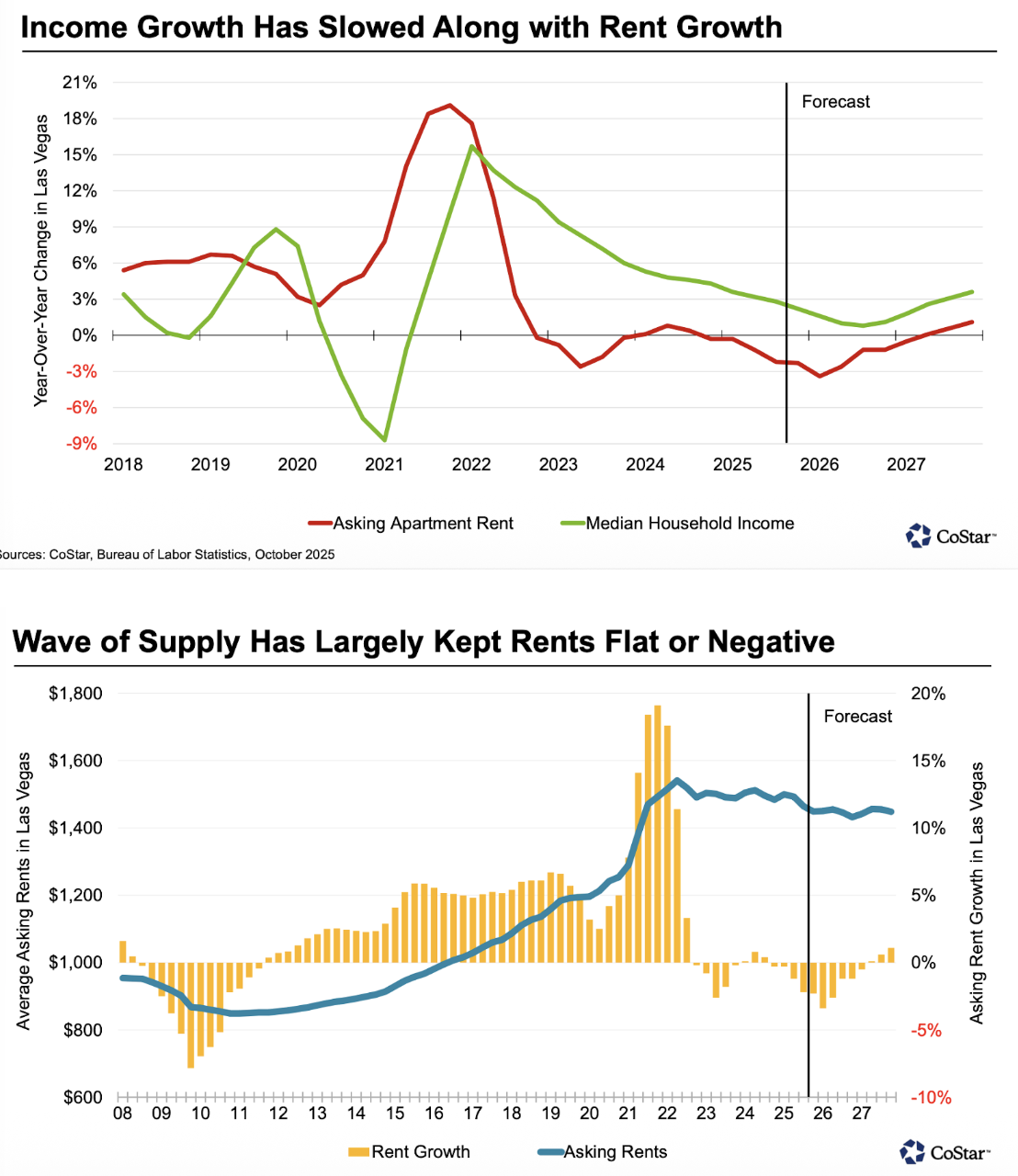
Rent growth has been flat to slightly negative since 2024
-
Roughly 50% of properties are offering concessions (free rent, discounts)
-
Concessions are concentrated in new Class A supply, not older stabilized assets
Investor Insight:
Class B and C assets in stable neighborhoods are better positioned for rent recovery between 2026–2028, once new supply pressure fades.
Employment & Income: Demand Drivers Remain Intact
-
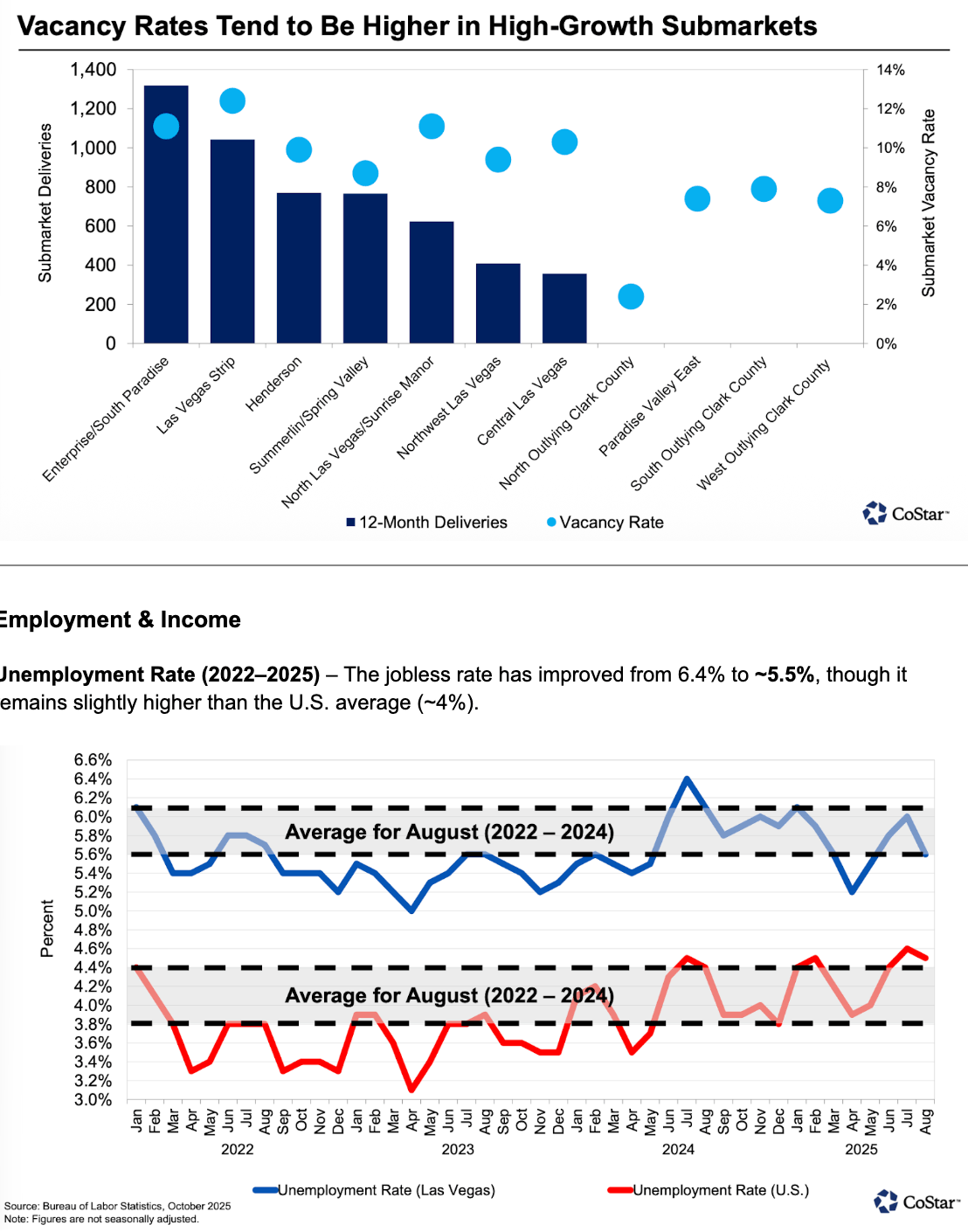
Unemployment improved from 6.4% to ~5.5%, though still above the U.S. average
-
Household income growth has slowed, mirroring rent growth trends
-
Affordability constraints are pushing renters toward value-oriented properties
Despite moderation, Las Vegas continues to benefit from:
-
Hospitality and entertainment employment near the Strip
-
Ongoing job creation in logistics, healthcare, and services
-
Strong workforce renter demand across multiple submarkets
Investor Insight:
Focus on employment-driven submarkets such as Henderson, the Southwest, and the Strip-adjacent corridor, where job density supports consistent absorption.
Demand & Absorption: Quietly Consistent
Net Absorption Outlook (2016–2027 Forecast)
-
Net absorption is expected to average ~700 units per quarter through 2027
-
Demand has remained mostly positive, even during peak supply years
By Asset Class
-
Class A: Absorption continues as renters prioritize newer inventory
-
Class B: Demand is accelerating due to affordability pressure
Investor Insight:
With absorption steady and new supply shrinking, market conditions are likely to tighten meaningfully by late 2026.
Key Takeaways for Entry-Level Investors
Short Term (2025–2026)
-
Flat rents and concessions create negotiation leverage
-
Sellers are more flexible on pricing and terms
-
Ideal environment for disciplined acquisitions
Medium Term (2027–2028)
-
Construction drop-off should drive rent recovery
-
Asset values likely benefit from tightening supply
-
Stabilized properties gain pricing power
Smart Target Submarkets
-
Henderson
-
Southwest Las Vegas
-
Spring Valley
These areas balance affordability, employment access, and long-term stability.
Summary
Las Vegas multifamily is transitioning from a short-lived oversupply phase into a healthier, tighter cycle. While headline rent growth remains muted today, the underlying fundamentals—slowing construction, steady absorption, and population-driven demand—point toward improvement.
For entry-level and mid-market investors, today’s softer conditions present an opportunity to lock in quality assets before the next growth phase begins.
FAQs: Las Vegas Multifamily Market (October 2025)
1. Is Las Vegas oversupplied right now?
Temporarily, yes—mainly in Class A properties. But supply is being absorbed and new construction has slowed sharply.
2. When will rents start rising again?
Most forecasts point to late 2026 into 2027 as supply tightens.
3. Are concessions a red flag?
Not necessarily. Concessions are common late-cycle and are concentrated in new developments.
4. Which asset classes are safest today?
Class B and C properties in employment-driven neighborhoods.
5. Is now a good time to buy multifamily in Las Vegas?
Yes—this is a pricing and negotiation window, not a peak.
6. Which submarkets look strongest long-term?
Henderson, Southwest Las Vegas, and Spring Valley stand out.
Categories
Recent Posts




GET MORE INFORMATION